Sanctuaries and Tourist Attractions: Do Elephants See Them as the Same?

When I was a little girl, my mother washed my hair every Sunday night in preparation for the school week. Back then you didn’t go to bed with wet hair; it was thought you could get a cold. So, while my hair was drying, I could sit in front of the television and watch Mutual of Omaha’s Wild Kingdom. Every time I heard the opening music of the show, I leaned forward and scanned the screen for elephants. If they were there, I willed my hair to stay wet and heavy.

On our recent trip to Thailand, we visited the Elephants Hills Sanctuary in Khao Sok National Park. We stepped out of the vans and watched the sixteen gentle giants emerge from the fields and walk in a single line towards us. The youngest was fourteen and the oldest was seventy-six. As we stood in the shade of the trees and listened to the guide, I slipped through the group towards the ancient female.

Mai Ri, the oldest elephant at the sanctuary, was born in 1943 when thousands of elephants were used as laborers to haul logs out of the Thai forest. They were used by the military to carry supplies, and they were captured in the wild and shipped to countries all over the world to work in circuses. Mai Ri has difficulty standing, so she shifts her weight from one leg to another. Her breasts sweep the earth as she walks, and she is blind in one eye. When she passes by a tree, her scarred ear flap catches on the bark and tears her already shredded skin. She has only one tooth in her mouth. No one knows her complete story; likely she was one of the rejected elephants found on the streets of Bangkok carrying tourists for less than a dollar a ride.

Before we bathed and fed the elephants, we got comfortable with their immense size by stroking them and touching their ears and trunks. The mahouts—the elephant caregivers who spend twenty-four hours a day with them—watched carefully and used commands and thin sticks to guide them. Mae Ri stood as if she were asleep while I patted her shoulder and ran my hand down her trunk bleached yellow from the years of sun.

We walked the elephants to a pond and stood on the trampled grass while the animals slid down the muddy bank. They blew water out of their trunks and jostled each other looking for the coolest spot. Mai Ri slowly sank to the bottom of the pond and rested there. Only her trunk was above water.  Soon, the mahouts spoke to the elephants and they all lumbered out, climbed the hillside, and rolled their skin back and forth, side to side, like ships bobbing on the water. Mud streamed from their sides and hit the path in circles. Mai Ri stayed on the bottom until her mahout crawled down the water’s edge and spoke to her. She followed the others to the bathing stations.

Paul and I joined Mai Ri at her pad. She waited for us, lifting her feet and swaying back and forth. Paul sprayed her with the hose, and I tossed buckets of water on her back. Together, we used coconut fibers to scrub her skin. Her one big brown eye gazed towards the empty, green field beyond us. A little afraid, I leaned my head to rest on a real-life elephant’s trunk. I felt her skin, smooth in some places and bristly in others.

I held Paul’s hand as we left the elephant sanctuary in the air-conditioned van. The driver (who I can only assume was fired upon our return) decided to take a short cut back to the camp. We bumped over craters in the road and rounded a corner where a traffic jam of vans was negotiating the entrance to a large, penned area with wooden viewing stands. Elephants wearing traditional Thai decorations stood in a line with giant rickshaw baskets high on top of them. They lowered themselves to their knees to allow people to climb them like a ladder. Once the baskets were bulging with people, the elephants stood up and began to walk. Heavy chains rattled with their footsteps, and they were prodded with a short hook, an ankus, by their mahouts. Riders kicked the elephants behind their ears urging them to go faster. The massive creatures ascended steep, man-made hills and the riders screamed as the basket slid backwards. They shouted as the baskets slid forward on the downhill side. As far as they were concerned, it was a roller coaster ride.

Is there a difference between the sanctuary and the tourist attraction? No one knows how many of Mai Ri’s babies were taken from her, how much pain and indignity she endured over the years, and even now, the performance she does twice a day at the sanctuary—swimming when she doesn’t want to, getting baths she does not need, and waiting to be fed by people afraid of her searching trunk—likely try her patience as an elderly matriarch.

The other people in the van shouted at the driver for taking us past the attraction. They contended we shouldn’t have been exposed to such cruelty. But not one of us unlocked those heavy van doors and demanded an end to the atrocity. ‘We went to a sanctuary,’ was the sanctimonious message passed through the seats as if that absolved us of putting our own desires above those of the elephants.

Travel industry experts say the elephants cannot be released into the wild because there is not enough habitat left to support them, and financial resources are limited, so there must be a means to recouping the costs.

Protected by the swaths of cool air and the guilty silence all around me, I sent a message out to the universe hoping Mai Ri recognized that my touch came from the truest part of me—my childhood self—and I wanted only to honor her. Given her long life, and perhaps her longing for her lost children, I hope she understood.

How Very Swiss-Like

(I’m tidying up my electronic files and discovered this one was left behind a few years ago…)

I am a person who lives by the ocean. I look out my window or stand on the beach and know that what I see and what I touch will not be the same the next time my gaze wanders back or I feel the rocky shore under my feet. In some moments on my trip to Switzerland I have felt a tightening in my chest and an impatience in my search for a limitless view. It was not the landscape that caused my distress, it was that I couldn’t connect. To put it simply, every time I called Switzerland, I got a busy signal.

To be amid such beauty—soaring, pointed, silent, massive Alps, glacier lakes in a teal green that forced a scream of ‘cold!’ from me each time I burst from the water, Heidi chalets tumbling across unbelievably emerald grass that undulates across the valleys in waves—all of it delivers such pleasure to the eye. However, beauty is not everything.

Someone told me once that people can be kind, but it does not equate to friendship. I would say that is true in Switzerland. Everyone has been unfailingly kind, but I have not met anyone who was willing to pull back the curtain and let me into their interior space where they unpin their hair and let it swing free.

For most people life is messy, and perhaps for some Swiss it is. Hot mess should be my first name. I am the one whose bra straps never tucked neatly inside my shirt as a teenager; I am the one who threw my head to the skies and howled to my children ‘you two are killing me!’; I am the one who “ugly cried” in public places and couldn’t stop it if I wanted to.

I want to be perfectly frank: I am writing about MY experience in Switzerland. I am writing from the lens in which I see the world. I know it is my experience, because I’ve spent the last few days wondering why I could not string together a few words to make a sentence. I’ve stared each night at a blank computer screen and questioned what was wrong with my fingertips. Most of the time they trip merrily across the keys. For a week they have been silent. They woke up this morning.

We left central Switzerland yesterday and drove as far south as possible while still staying in the country. We are in Gandria, a tiny hill village on Lake Lugano, a few miles from the border with Italy.  There are four languages spoken in Switzerland—German, French, Italian, and Ramanesh (an old dialect of Italian). If you divide Switzerland into sections that touch the surrounding countries, you can see that the Swiss who live in Geneva and farther east speak French while the Swiss who live in the north, for example Appenzell, speak German. Here in the south Italian is the language for the Swiss, but in my experience, I see no Swiss—it’s Italian through and through.   

The sound of people speaking Italian swirls around me like curling wisps of smoke. “Buongiorno!” cries the tabbacci shop owner as he peels back the doors to his kiosk. “Buongiorno,” sings the waitress next door as she sweeps crumbs from the table. We even got a muttered “Buongiorno,” from a grisly fisherman as he passed us in his dory while we bobbed in the lake during our morning swim. My heart is light, I traipse along the crooked, stone paths, and my smile is wide as I raise my wine glass and grin at the waitress.    

Why is it that I can embrace one culture and be untouched by another?   

There is only one war memorial in Switzerland. It is the Lion of Lucerne, carved into a rock in Lucerne. It is a dying lion, head in anguish on its paws, lying on its side. It commemorates the Swiss Guard soldiers who were killed in 1792 during the French Revolution. The monument is visited by over a million people each year in Switzerland. It acknowledges the loss Switzerland endured fighting for someone else. Mark Twain called it “the most mournful and moving piece of stone in the world.” The Swiss revere the monument but still feel the sting of its controversy. Switzerland is adamant. They will not glorify a moment in history where Swiss citizens died for a foreign monarchy. After the defeat in France, the country turned inward—developed their own economy, kept their own counsel, stated their own neutrality. That is the way it has been for generations, despite what happened to the rest of the world.

So, it has me thinking about the concept of collective history. I do not advocate for war as a resolution to a disagreement, but I do believe in two things: the value of speaking your mind and acting with your heart. Simple, I know, but those two values have been my North Star. Collective history means we were all there even if we saw it from different perspectives. It means we were all changed in some way and the memory of the events continue to inform us over time. Being a part of something bigger than yourself allows you to become something more. You may not have thought you had the courage to do something unknown, but with allies on your side, you trust someone has your back. Leaders are created through collective history. Leaders emerge because of events, not in spite of them. Sacrifice inspires us to find a common purpose and to rise above the fray.       

A few years ago, we visited Normandy, France, and Paul and I walked along some of the D-day beaches. We sat on the bus with people from Canada, England, France, and even Germany. Being American, I expected the tour to be all about the American’s role in D-day, but I was soon silent in shame. Yes, the United States landed on Utah and Omaha, but the British stormed Gold, the Canadians fought on Juno and the British and the French commandeered Sword. Collectively, eight allied countries, 7,000 ships and landing craft, and 160,000 troops stepped onto French soil on June 6, 1944.

The Swiss did recently break with some of its strictest approaches to neutrality—they joined the U.S. and others and imposed sanctions on Russia after it invaded Ukraine. They also contributed 1.3 billion francs to aid Ukrainian refugees.    

So, what does this have to do with Switzerland and my struggle to connect?  I’m not sure. Just as I choose to stand on my ever-changing beach with its detritus floating in from all directions, the Swiss have their immovable mountains. We each know our place in the world, but perhaps visiting one another is worth answering the call.   

Saving Italy

(I’m tidying up my electronic files and discovered this one was left behind a few years ago…)

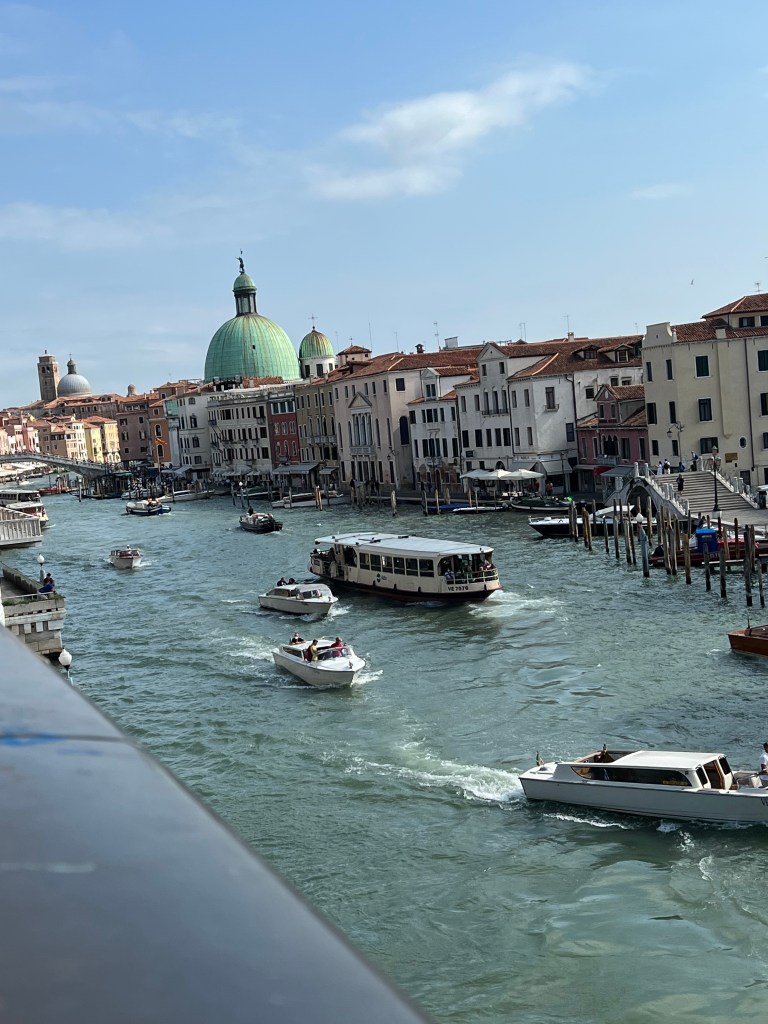
We made our way to the crown jewel of Venice—the top of the Rialto Bridge that slices across the Grand Canal. The aquamarine water churned below us, and boats of all kinds dashed helter skelter across the rushing water. Black gondolas with curved tips steered by with men in striped shirts poled and oared with the precision of threading a needle. Lacquered speed boats rode low in the water with tinted windows and hidden occupants going to even more secret destinations. My least favorite, the vaporetto (government water taxis), chugged up and down the canal picking up and dropping off passengers in a smog of diesel fumes. The commotion, the fervor, the energy was intoxicating.

Paul squeezed my hand. I squeezed back. It was our signal born of twenty years of marriage where we had to sneak around our three children to have some semblance of a love life.

Before we met, I felt seasoned by life and was sure, even as a single mother, I knew what I was doing. I could work all day, drop one child off at baseball, pick up the other child from art class, get us all home, take the pantyhose off, feed the dog, pop the frozen chicken cordon bleu in the oven, put peas in the microwave, and crack the lid on the 1-minute rice. In 18 minutes, we sat down for dinner. Later, after the homework and brushed teeth, we all went to bed. In the space between the efficiency and the certainty however, I was lonely. I read books in the silence, a cat laying at the very end of the bed my only companion.

Then it all went to hell. We met, dated, and got married all within a year. There were three kids to haul around, a new house with acoustics that made it sound like I was the one playing Call of Duty, a fenceless yard that caused us to cajole and beg the dog to come in from the night, homework was forgotten, and cavities happened. Life was no longer lived with a precise certainty, but I was happy. A husband lay beside me each night.

That brings us to our 20th wedding anniversary trip—three weeks in Italy. The children are grown, I’m paying the dog sitter $75 a night for peace of mind, and there is a nine-hour difference between Europe and Washington state. Everything is in place. An open-ended, lazy schedule has allowed for plenty of time for…hand squeezing.

“Where are your pills?” Paul looked up from the toiletries bag he was unpacking.

“Here,” I held up my daily vitamins and apple cider vinegar pills.

“Not those,” he said. “You know…the medicine.” He gave me his little boy it’s-almost-Christmas-morning face.

“Oh no,” I sat down on the edge of the bed and twisted my socks in my hands. “I forgot that medicine.”

Paul’s face looked exactly like it did in 2011 when Michigan beat Ohio State scoring 40 points in the game. Coach Urban Meyer had let him down that day. Now it was my turn.

I have chronic bladder infections caused by narrow ureters that hold onto germs and turn them into infections. These infections aren’t the kind where you just take some drugstore pill that turns your pee orange. My bladder infections cause me to scream in childbirth-like pain and, as Paul drives me to the emergency room, I yell at him that it is all his fault for injecting germs into my ureters.

It was an untenable situation until a kind, elderly doctor wrote me a prescription for Macrobid, an antibiotic, and leaned into whisper, “Take one after intercourse. It’s enough to kill the infection in its early stages. But,” he cautioned me, “no more than four in a day.” Right.

So, what does all this have to do with Venice? Everything. Absolutely everything.

The next morning while Paul was still sleeping, I decided to find a pharmacist in a city with maze-like corridors, twisting waterways, and bridges to somewhere that become nowhere. The faded Italian lettering on the sides of the buildings was meaningless to me. I opened up Google maps without a lot of felicity; I’m a give-me-the-directions kind of girl. And, I have a history. I get lost everywhere. I went to a mall in Thailand and forgot my phone; I wandered around Notre Dame in circles and finally collapsed in a Chinese food restaurant and cried; I took the wrong staircase to our resort in Zihuantanejo and ended up in a secret drug meeting in the jungle run by the cartel (I think). Hence, Paul doesn’t trust me to go anywhere in a foreign country by myself. But, this was important. Italy would not be Italy if…well, you know.

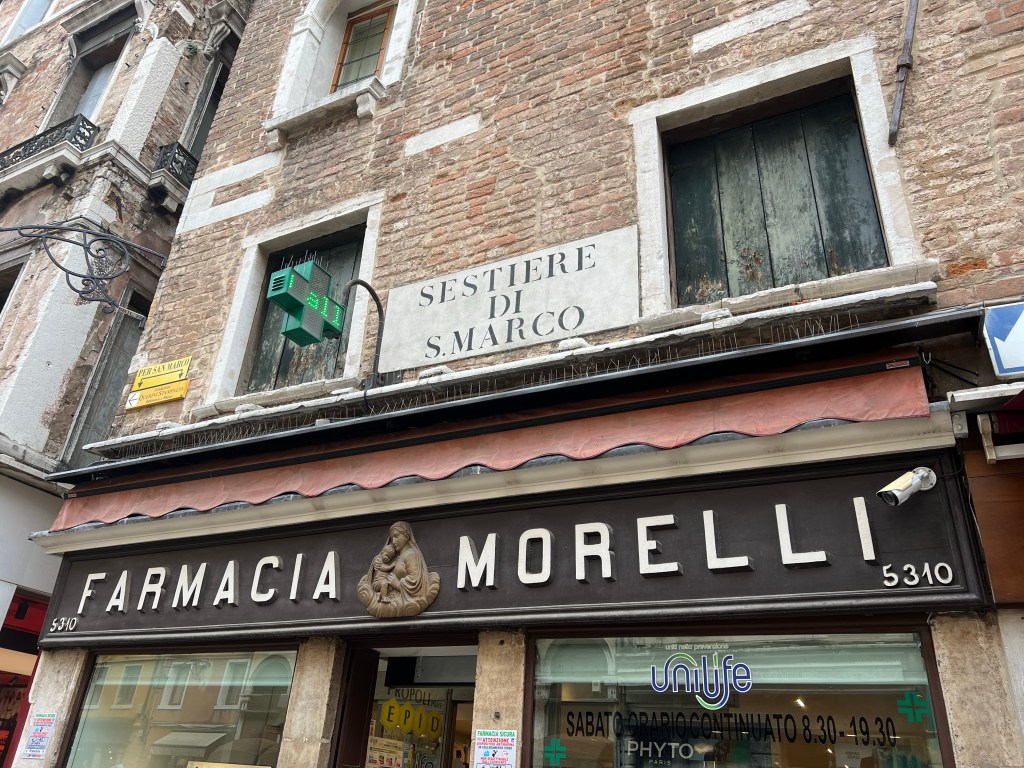
I somehow made it to the Rialto Bridge. I waded into the mass of people swirling around the coffee places, elegant stores, and tabbacci shops. On my phone screen I looked at the picture of the Farmacia Morello. I ignored the address. Landmarks. I needed landmarks. Google answered my prayer. Basilica S.Maria Gloriosa dei Frari rose out of the melee, and blessings of all blessings, the Farmacia with the bright green cross stood across the street.

“May I help you?” A young man with a nose ring and curly black hair leaned forward and I cleared my throat.

“Macrobid? Do you have it?” I stood up straight and tried to look respectable—not like a foreign hussy.

“That medication is an antibiotic. You need a doctor note,” his eyes were kind above the nose ring.

“I have a prescription. The medicine is at home. I am on vacation,” I paused for effect. “with my husband.” I tried my best to look rational. He knew that I knew that we were playing the let’s-not-talk-about-what -we’re-really-talking-about game.

The pharmacist studied me for a moment with his head titled to the side. “Okay, okay.” He hustled behind the counter bending to grab a white box. “I give you Macrobid.” He handed me the box. “Seven euros.”

“Seven? I echoed.

“Yes, ma’am. There are twenty pills. Will that be enough?”

“It better be,” I muttered. “Grazie.” My head held high, I sashayed out of the farmacia. I could tell he knew it wasn’t just about sex; it was about the Call of Duty, the recalcitrant dog, and those subsequent visits to the dentist. We’d put in the time then, now was the payoff.

So, that is how I saved Venice. And Florence. And Tuscany, Rappallo, and Rome.